
Drive belts are one of the most common wear items on automatic sliding door operators. Nearly all sliding doors use a toothed belt to drive the carriage along the track — swing and folding doors rarely use belts, relying instead on mechanical linkages or direct drive. When a belt fails, the door stops working — but belts aren’t always the first thing to check. This guide covers when to suspect the belt, how to identify the correct replacement when the part number is gone, and what to check before ordering.
When to Suspect the Belt
Before jumping to the belt, rule out the more common causes of door failure first:
- Sensors — dirty or misaligned presence sensors keeping the door in hold-open
- Controller — fault code on the controller, blown fuse, or software lock-up
- Power supply — no power to the operator, tripped breaker
- Motor — motor windings failed, capacitor degraded
- Mechanical bind — track obstructed, rollers seized, carriage jammed
Once you’ve ruled those out, belt failure is a common cause. The symptoms:
- Door stuttering or jerking — teeth worn or stripped, belt jumping on the pulley
- Squealing under load — belt glazed or tension too low
- Door slipping or losing position — belt stretched beyond adjustment range
- Visible cracking, fraying, or tooth damage — belt at end of life
- Door doesn’t move but motor runs — belt snapped or stripped completely
Open vs Closed Belts
Before measuring anything, you need to know which type of belt your operator uses:
- Open belts — a straight length of toothed belt, sold by the metre. You cut it to the required length and join the ends around the carriage using a belt clamp or connector plate. Most sliding door operators use open belts.
- Closed belts — a continuous loop with a fixed tooth count. You cannot cut or join these. They must be ordered to the exact size. Some older operators and certain models use closed-loop belts.
The identification process is similar for both — you still need pitch and width — but how you determine the length differs.
How to Identify a Belt With No Part Number
Once you’ve confirmed the belt needs replacing, you need three measurements:
1. Pitch
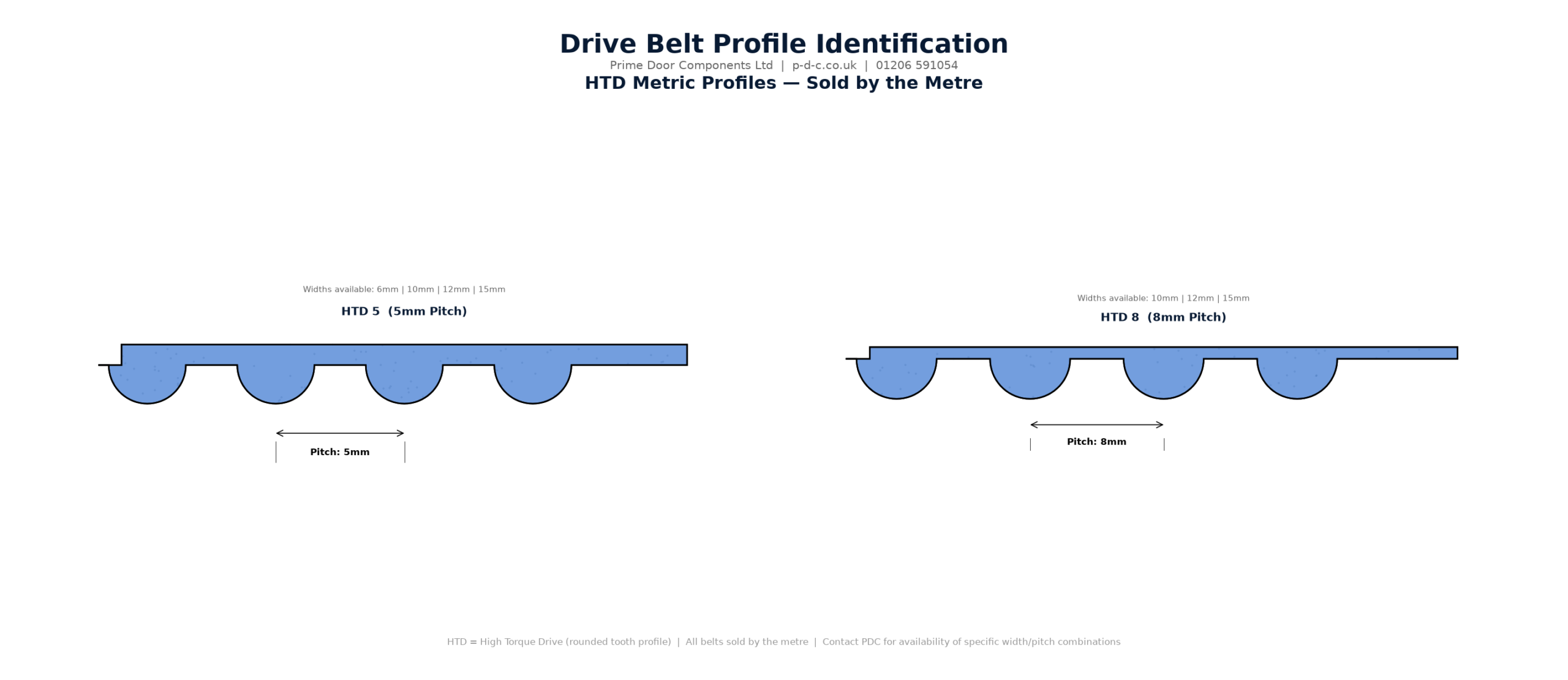
This is the distance between the centre of one tooth to the centre of the next. The most common pitches on automatic door operators are:
- HTD 5 — 5mm pitch (the most common — Record STA 16/17, Dorma ES200, many others). Available in 6mm, 10mm, 12mm, and 15mm widths.
- HTD 8 — 8mm pitch (heavier operators — Horton 2003, some FAAC). Available in 10mm, 12mm, and 15mm widths.
Measure centre-to-centre on a few teeth. A 5mm pitch belt will measure 50mm across 10 teeth; an 8mm pitch belt will measure 80mm across 10 teeth.
2. Width
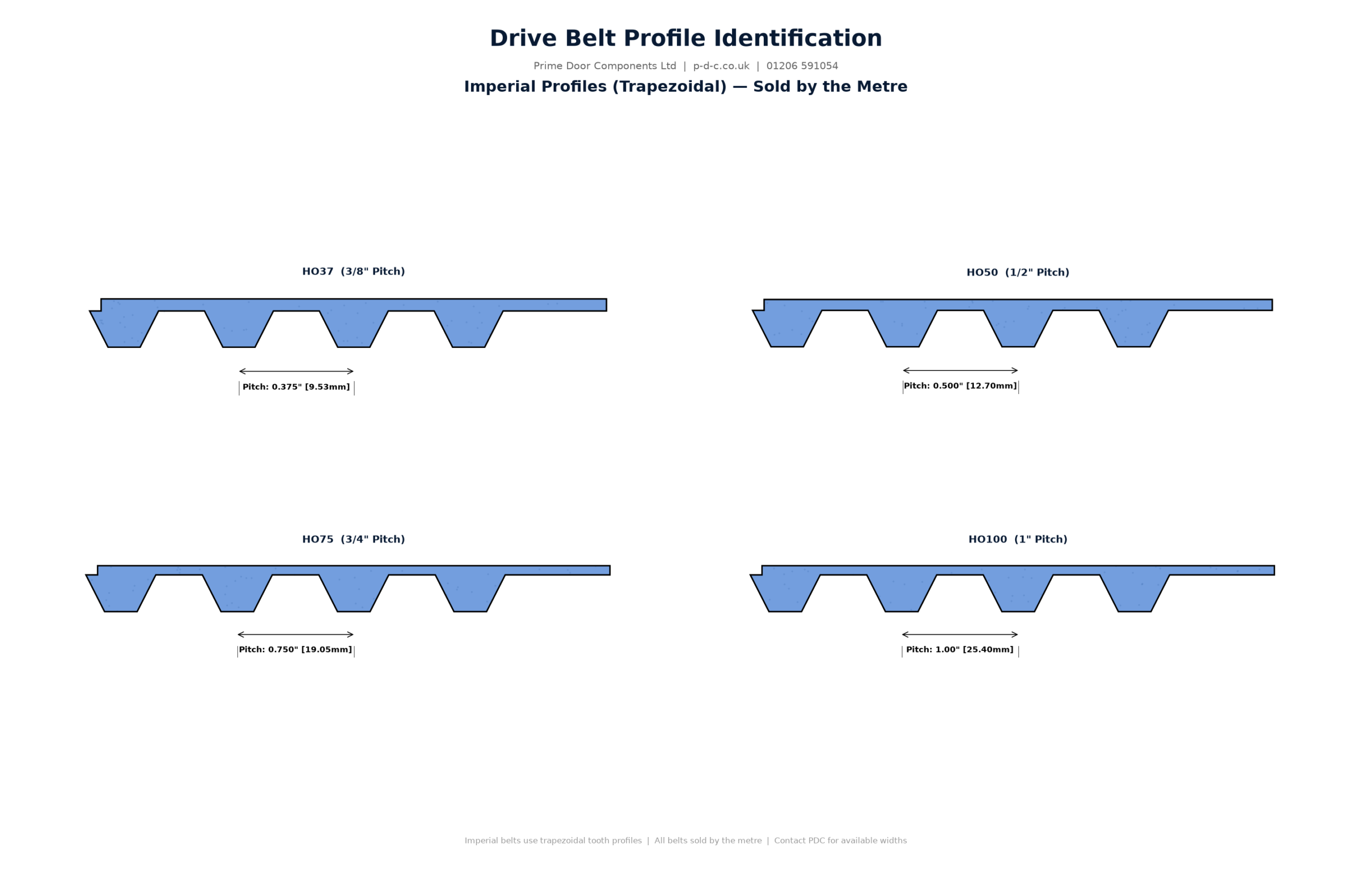
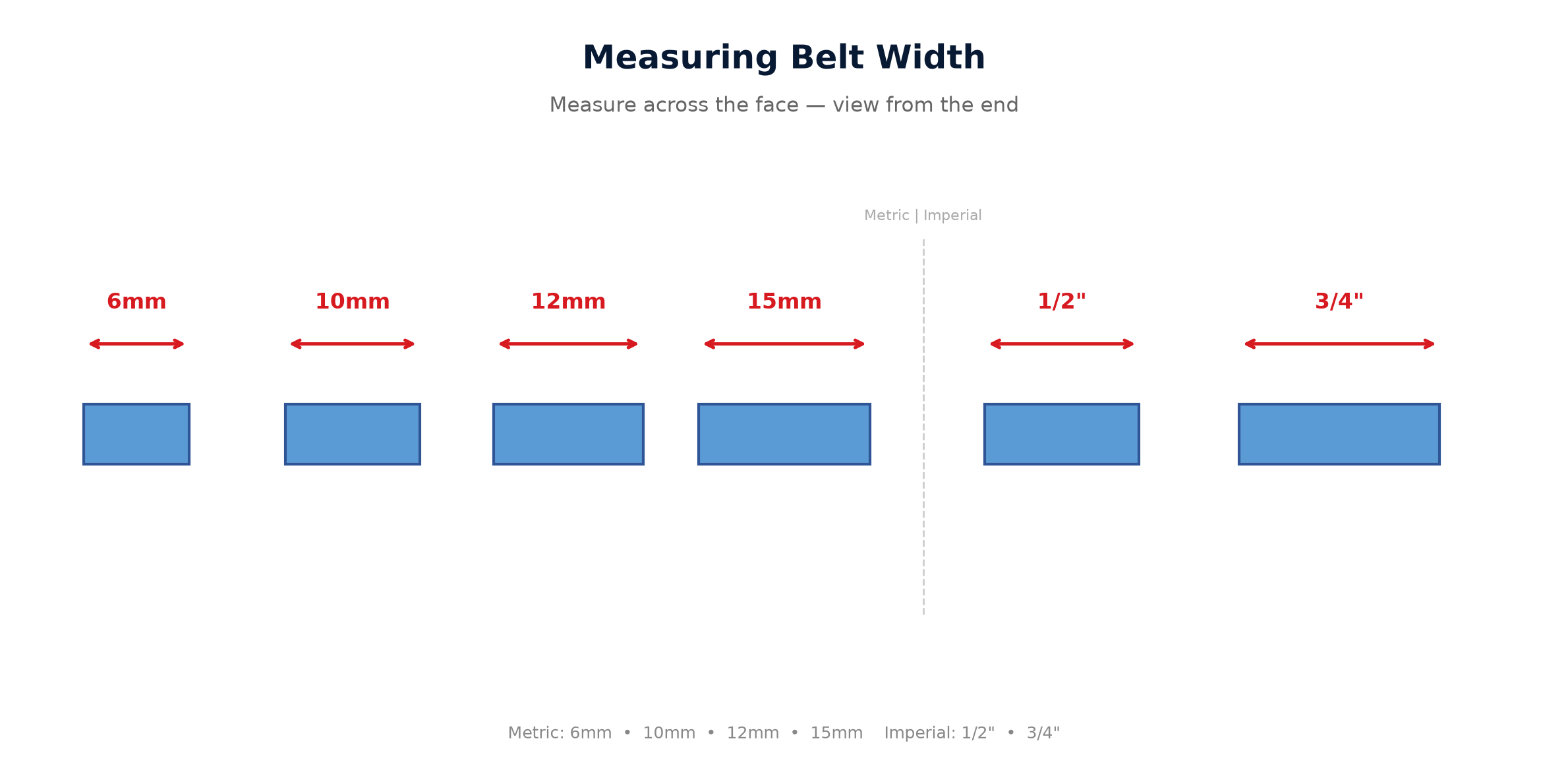
Measure the belt width across the face. PDC stocks metric belts in 6mm, 10mm, 12mm, and 15mm widths. For imperial operators, we stock HO37 (3/8″ pitch), HO50 (1/2″ pitch), HO75 (3/4″ pitch), and HO100 (1″ pitch) — all sold by the metre.
3. Length
How you determine the length depends on whether the belt is open or closed:
- Open belts — measure the length of the old belt, or measure the belt path on the operator (around the pulleys and across the track). Add a small amount for the clamp joint. Open belts are sold by the metre, so you buy the nearest length above what you need and cut to size.
- Closed belts — count the teeth on the old belt. This is the most accurate method. Many closed belts also have a code printed on them like “500-5M-25” which means 500mm length, 5M pitch, 25mm width. If the belt is snapped and you can’t count teeth, lay it flat and measure the full length, then divide by the pitch to get the tooth count.
HTD vs Trapezoidal Belts
Most modern door operators use HTD (High Torque Drive) belts — these have rounded teeth that mesh cleanly with the pulley. Older operators may use trapezoidal (flat-sided) teeth. The two are not interchangeable — check the pulley tooth profile if you’re unsure. HTD belts are marked with codes like HTD 5 and HTD 8. Imperial trapezoidal belts use the HO designation — HO37 (3/8″), HO50 (1/2″), HO75 (3/4″), HO100 (1″).
Identifying by Operator Model
If you know the operator model, that’s often the fastest route. At PDC we stock drive belts for all major manufacturers. Here are some of the most common ones we get asked for:
- Record — STA 12/13/14/15, STA 16/17, STA/STM 20, STG 16 Fold
- Dorma — ES200, ES 60/70/90 Series, Compact
- Besam — Unislide, EML, EMD/EMJ/EMDE, EMC, SL500
- Geze — SL/SC/SCR DCU/EC/NT, 350N
- Tormax — TEP/TLP/TSP/TFP/TKP/TMP, TOP Motor, TFP Motor, Windrive
- Ditec — Evolus/Valor/Ten, BIS
- FAAC — A100, 930
- Horton — 2001, 2003 (available in 1/2″ and 3/4″ widths)
- Label — Eterna 90, Eterna 150, Butterfly/JMD
- Gilgen — SL35, SLM (early and late types), SLX
- Stanley — Duraglide, Duraglide ‘J’
If your operator isn’t listed, call us — we stock belts for over 60 different operator models and can cross-reference by manufacturer and model number.
What to Check Before Ordering
- Check the pulley teeth — if the old belt stripped, debris can be lodged in the pulley grooves. Clean them out before fitting the new belt or it won’t seat properly and will fail prematurely.
- Check belt clamps — if your operator uses an open belt, check the clamp plate that joins the belt ends. If the clamp is worn or distorted, replace it at the same time. We stock clamp plates for common models like the Dorma ES200.
- Check the belt tensioner — if the belt stretched because the tensioner was maxed out, the new belt may not tension correctly either. Check the tensioner has enough adjustment range left.
- Check for misalignment — if the old belt wore on one edge, the motor or idler pulley may be misaligned. Correct this before fitting the new belt or it’ll wear the same way.
- Confirm the tooth profile — HTD and trapezoidal belts look similar but are not interchangeable. Check the pulley tooth shape before ordering.
Tensioning After Replacement
Once you’ve fitted the new belt, correct tension is critical:
- Too loose — belt will slip under load, door will stutter or lose position
- Too tight — puts excessive load on motor bearings and pulley shafts, premature wear
A properly tensioned belt should deflect approximately 10-15mm when pressed firmly at the midpoint between the two pulleys. Most operators have a tensioning adjustment on the motor mount — slide it to take up slack, then lock it off. Don’t overdo it.
Top Tips From the Trade Counter
- Carry the common ones — if you service multiple sites, keep a 5M 12mm belt on the van. It fits more operators than any other single belt type.
- Stock belts for the models you maintain — if you service a site regularly, make sure you carry the belt that fits the operator models on that site. When a belt fails, having the right one on the van means one visit, not two.
- Replace in pairs on telescopic doors — telescopic operators have primary and secondary belts. If one fails, the other isn’t far behind. Replace both.
Need Help Identifying Your Belt?
If you can’t find the part number or aren’t sure which belt fits your operator, call our trade counter on 01206 591054 or email sales@p-d-c.co.uk. Tell us the operator manufacturer and model, or bring the old belt in — we’ll match it from stock.